Work continued across XMR20 after our previous edition. This update brings together the wallet and CLI progress from later on 21 October with the market and privacy research taking shape on 22 October.
Our focus is practical: make it easy for people to interact with XMR20 tokens on native Monero. We are building out the Chrome wallet and CLI tools with that goal in mind, laying the groundwork for people to trade tokens against XMR on Monero Market in the future.
A clearer, more compact wallet experience
21–22 October
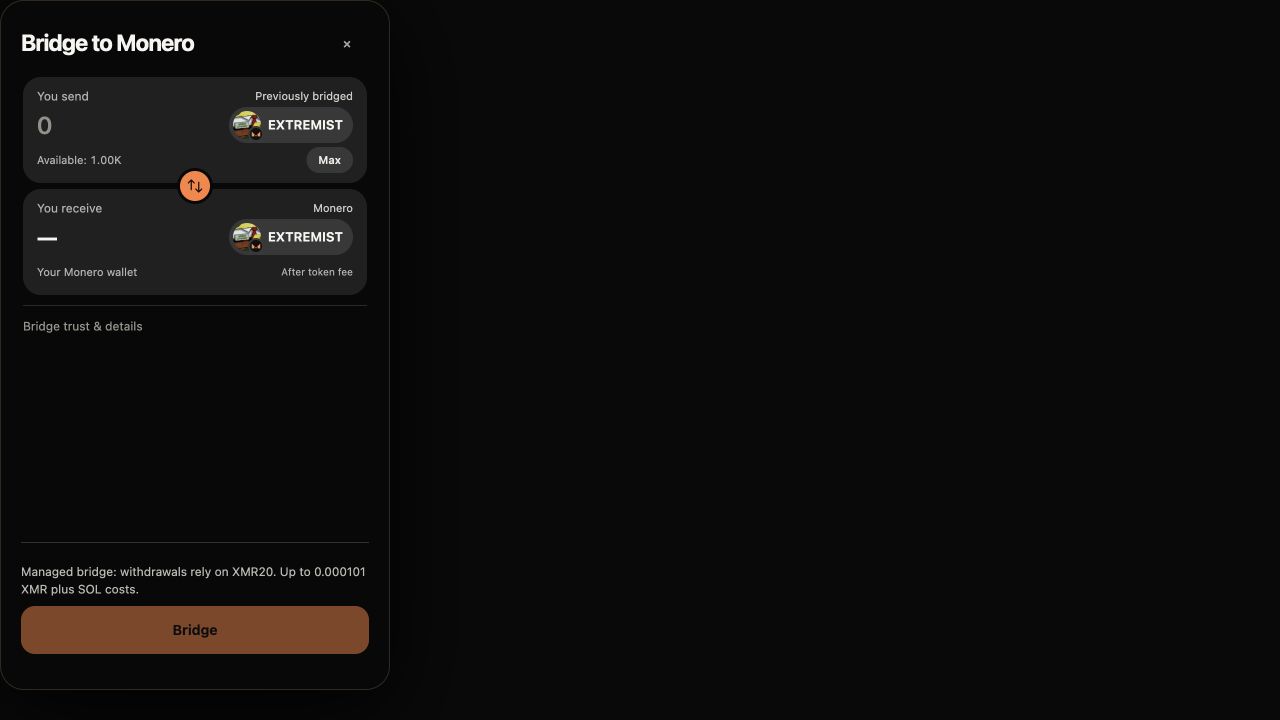
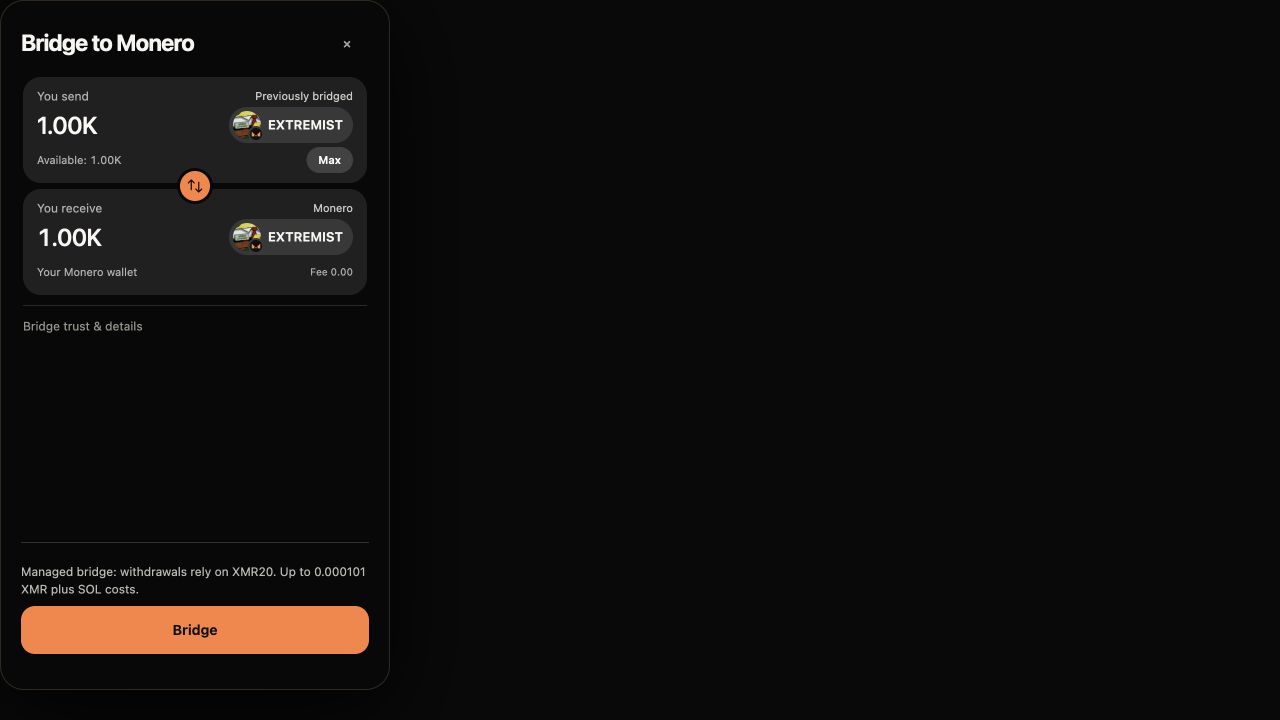
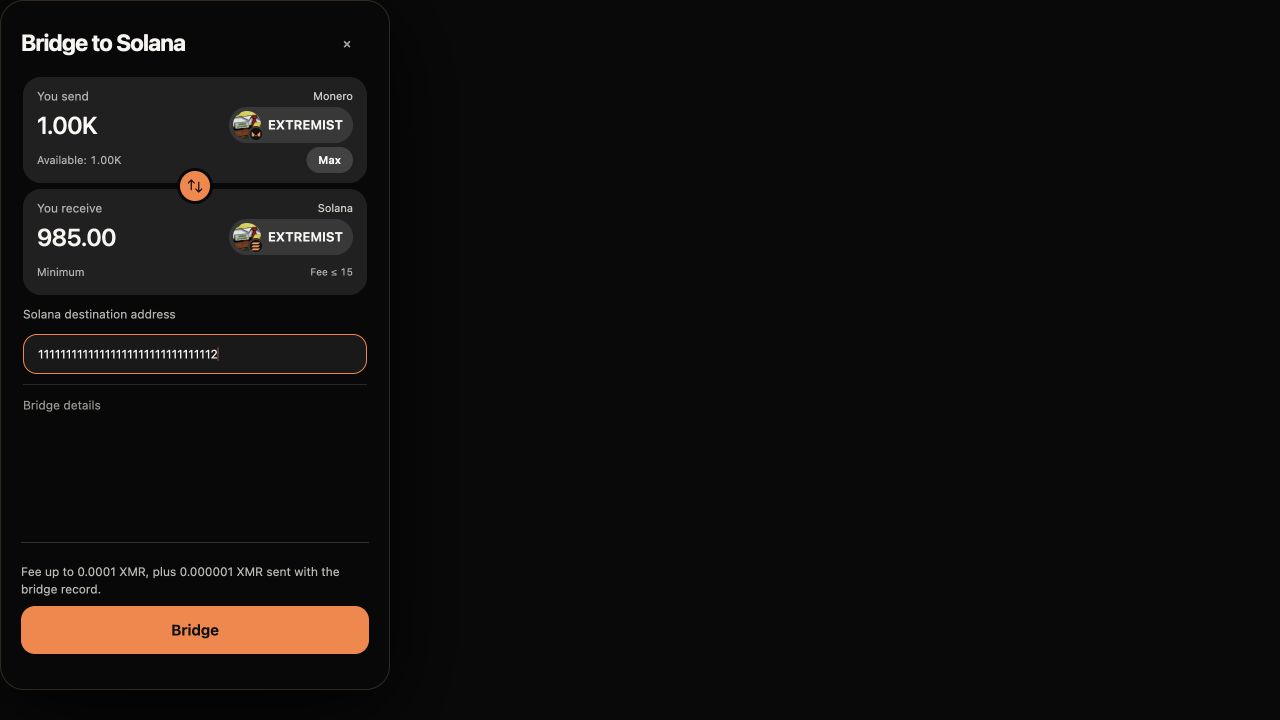
The Chrome extension gained a refreshed bridge layout with dedicated You send and You receive panels. A direction-switch button makes it easier to move between the Monero and Solana flows, while the receive panel shows the token fee alongside the expected amount.
A closer look at the bridge
Actual wallet UI in an isolated demo. Sample balances and destination; captured screens, no real transaction.
The bridge keeps the token, source and destination together, with an empty amount field and a visible Max button.
The bridge keeps the token, source and destination together, with an empty amount field and a visible Max button.Max fills the sample balance of 1,000 EXTREMIST. The receive panel shows the expected amount and token fee before approval.The return screen shows the sample 1,000 token amount, a 15 token fee and 985 tokens to receive. This is an isolated demonstration.The compact layout was checked at a 360 × 600 popup size, keeping the ready bridge forms and their primary actions visible without scrolling. Exact amounts remain available beneath the compact display, with network fees presented before approval.
Saved bridge operations are easier to reach from Activity and the bridge screens, so users can return to an existing setup. Further work brought token and XMR scanning together more closely and improved the clarity of funding and transaction progress.
On 22 October, the locally installed 0.1.95 development build added a separate SOL ↔ XMR tab using ChangeNOW. The supporting quote route was published and a live quote was checked; funded exchange validation is the next milestone for this addition.
Wallet 0.1.95 source is now available for public review in GitHub pull request #6. It includes the native Bridge to Monero and Bridge to Solana screens, Monero token sends, the compact bridge interface and the SOL ↔ XMR exchange workflow.
For the first time, the pull request also makes the client-side native bridge protocol code available in the public repository. Token credit and redemption clients, transaction records and recovery components give developers more of the implementation to explore, alongside tests and package build instructions. The pull request is open for review.
What we checked
The 0.1.93 and 0.1.94 development builds each recorded 561 passing extension tests, with navigation and compact-layout browser checks. The later SOL ↔ XMR release record confirms the supporting route, quote check and local 0.1.95 installation. These are development extension packages. Separately, PR #6 reports 554 passing tests and six passing gateway tests from its source checkout, plus successful bridge and native-package builds. Those checks cover the published source snapshot; funded flows on a build from that checkout are a separate validation stage.
More functionality from the terminal
21 October follow-up
The CLI progressed from the first 0.1.0 candidate covered in our previous edition to a local 0.2.0 managed-bridge testing candidate. It adds deposit, return, status and resume commands, bringing more of the token workflow into the terminal.
Durable operation records and bridge-aware backups preserve the information needed to return to saved work. Interrupt handling and explicit review remain part of the workflow, with the candidate using the reviewed native engine and custody/redemption clients.
Validation covered terminal interactions, the actual wallet engine, simulated Solana execution and read-only public-chain scanning. Imported owner wallets remain read-only in this candidate; funded bridge testing is a separate validation stage.
What we checked
Recorded checks include 26 CLI unit tests, three browser integration tests, nine terminal acceptance checks and six hidden-prompt checks. A disposable-wallet public-chain scan and subsequent incremental scan also completed. The CLI remains a local testing candidate.
Building out trading against native XMR
21–22 October
We are continuing to build out Monero Market for native XMR20 tokens traded against XMR. The XMR20/XMR preview below illustrates that direction, while development focuses on the connected wallet, transaction preparation and the full order lifecycle.
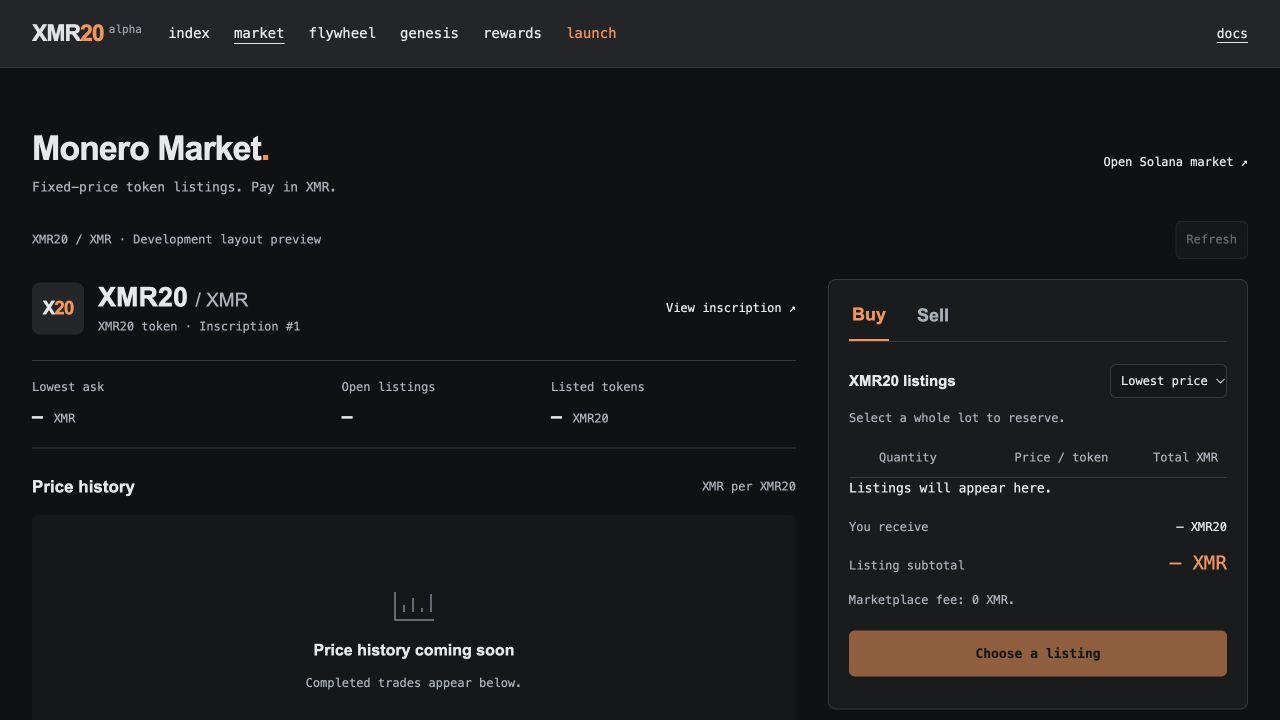
Development layout preview using the existing market interface. XMR20 is the illustrative pair; no live orders or trades are shown.
The latest wallet and CLI work adds tools for following saved operations and checking their status. In parallel, isolated market research is exploring purchase, cancellation and recovery workflows for a proposed private-token format.
That experimental private-token market is research separate from the published interface. Settlement design and independent review are required before it can be used with real funds.
What we checked
The existing interface publication is recorded separately from the offline research. Recent research exercised two-wallet purchase, cancellation and encrypted recovery scenarios using synthetic funds, with a review package documenting the settlement work still required.
Researching private XMR20 transfers on Monero
21–22 October
We are researching a private transfer format for XMR20 tokens carried by native Monero transactions. The experimental design uses encrypted token records and cryptographic proofs to explore private ownership and transfer validation.
In isolated testing, the prototype combined up to three pieces of one holder’s token balance into a single Monero transaction, including encrypted recipient and change records. This is a concrete research milestone toward more flexible private-token transfers.
A separate scaling experiment processed one million encrypted token records, followed by another 10,000 records, and recovered the expected wallet balances. Those measurements covered record indexing and recovery; proof admission and full blockchain validation were separate from the million-record benchmark.
This work remains an isolated research prototype. Independent cryptographic review and production integration are future validation stages; the research does not change the privacy properties of today’s live XMR20 tokens.
What we checked
The multi-input prototype recorded 61 passing checks across cryptographic validation, compact record handling, wallet recovery and offline native-transaction integration. The separate scale experiment verified balances and incremental updates against its generated encrypted-record dataset.
Evidence & release status
This edition combines work from later on 21 October and 22 October that was not covered in Edition 2. The table and downloadable editorial summary distinguish published interfaces and services, locally installed development builds and isolated research. Test results describe the specific recorded runs.
| Workstream | Recorded state |
|---|---|
| Chrome extension | Source on GitHub · development builds |
| CLI wallet | Local testing candidate |
| Monero market | Interface live · development ongoing |
| Privacy research | Isolated research prototype |
What comes next
The work connects four priorities: a clearer Chrome wallet, more capable CLI tools, a native XMR market and carefully tested private-transfer research. We will keep sharing concrete milestones as each area progresses.
Back to all updates