Since Edition 06, we have brought a clearer choice into the native-token wallet we are building: straightforward public token transfers, with explicit controls for moving into and out of a private balance. The new format has already completed a full rehearsal on Monero stagenet, building on the testing reported in our previous updates.
Alongside the wallet work, we have developed the persistent indexer and bridge services, rehearsed migration claims against the shape of existing holder records, and published more source and results on GitHub. The redesigned xmr20.org homepage is also live, bringing tokens, collections and Monero artwork into a clearer browsing experience.
The goal remains easy interaction with XMR20 tokens on native Monero, with a foundation for future native trading on Monero Market. The new token format, wallet controls and migration path described below are experimental work under testing; the homepage and rewards update are already live.
Public transfers and private transfers, with a clear choice in the wallet
25–26 October
The latest experimental format introduces two clearly labelled balances. Tokens start in the public balance, where ordinary token sends use one Monero transaction and the token details are visible. Shield moves tokens into a shielded balance; Private send moves shielded tokens privately; Unshield returns them to the public balance.
A private send from an already shielded balance uses two Monero transactions, combined into one token operation. Shielding is a separate transaction, and unshielding uses a transaction for each selected note. The popup shows the transaction count, each network fee and the total before approval. Bridging uses the public balance and never silently unshields tokens.
The complete new-format flow ran on public Monero stagenet: public credit, public send, shield, two-part private transfer, unshield and burn. Every carrying transaction passed the node’s normal validation and reached ten confirmations. The wallet replica and indexer agreed on the resulting token balances.
This rehearsal used the transaction engine and a scripted workflow. Separately, the actual popup passed local tests covering the public and private controls, recovery between the two parts of a private send, and restoration in a fresh profile. The new proof integration uses Penumbra’s published spend and output parameters, with their file identities checked by the wallet.
What we checked
The new-format stagenet run completed between 25 October 21:56 UTC and 26 October 00:05 UTC using synthetic tokens and faucet coins. Its six logical records were carried in seven Monero transactions. Both parts of the private transfer fit the tested tx_extra limit. Browser-popup testing for this new format was local; the stagenet rehearsal did not include a Solana payout. Published parameter files were checked against their recorded identities; this does not constitute independent review of the complete token protocol.
Building the services around the token workflow
26 October
The new indexer saves its progress as it follows the chain, then resumes from that saved state after a restart. It can also follow a change in chain history and rebuild the affected token state. In a read-only stagenet check, it reconstructed the new rehearsal’s records and resumed with the same resulting ledger state after restarting.
The bridge-service tests connected deposits, public token credits, transfers, burns and payouts in a local simulation. They checked that completed receipts are recognised, operations can resume after service restarts, and a repeated request does not create another credit or payment. Accounting followed the tokens and backing through the tested flow.
We then exercised the Solana RPC custody adapter against a disposable local validator. The rehearsal completed a deposit, receipt lookup, redemption and reserve check, including refusal of a duplicate request. This extends the work from the simulator to an actual local Solana node.
We have also prepared configuration and explicit network-activation checks for a controlled experimental pilot. These are preparation and validation milestones; the new services have not been deployed for public use.
What we checked
The persistent indexer replayed the six stagenet records and retained the same ledger root after restart; the rebuilt version repeated the read-only check in 2.75 seconds. Local bridge-service suites passed, followed by the RPC adapter rehearsal on a disposable solana-test-validator. Mainnet activation checks passed 3/3. No devnet or mainnet custody run, public pilot or funded production release is claimed.
Connecting migration tools to existing holder records
26 October
The migration work has moved beyond the earlier synthetic token catalog tests. We checked the public holder records used by existing Monero-side tokens and built snapshot tooling around their actual structure: the token’s mint address, the holder’s Monero address and the exact token amount.
A read-only dry run checked five token assets and 17 holder rows, with the totals matching across the captured records. This did not freeze the ledger or move anyone’s tokens; it exercised how a future migration snapshot can be assembled and checked.
A separate rehearsal then took two synthetic holders through the complete claim path: snapshot, per-token registry, a claim signed locally by the wallet, and an exact credit into the new public token balance. Entitlements of 10,000 and 2,500 tokens were preserved in full and were spendable afterwards. Duplicate and invalid claims were refused.
The candidate now includes the snapshot builder, claim verification and a migration screen in the test popup. This gives us a concrete workflow to review before choosing a cutover and activating any real claims.
What we checked
Public-data inspection covered five assets and 17 holder rows. The complete claim and spending rehearsal used two synthetic holders with the actual holder engine on a local test chain. No real holder migrated. The cutover, transfer of legacy backing and activation of claims remain separate decisions and operations.
A new home for tokens and art on Monero
26 October
The redesigned homepage is live. Its new introduction, “Tokens and art that live on Monero,” leads into token discovery and a larger featured artwork: The Starry Night from the Genesis collection.
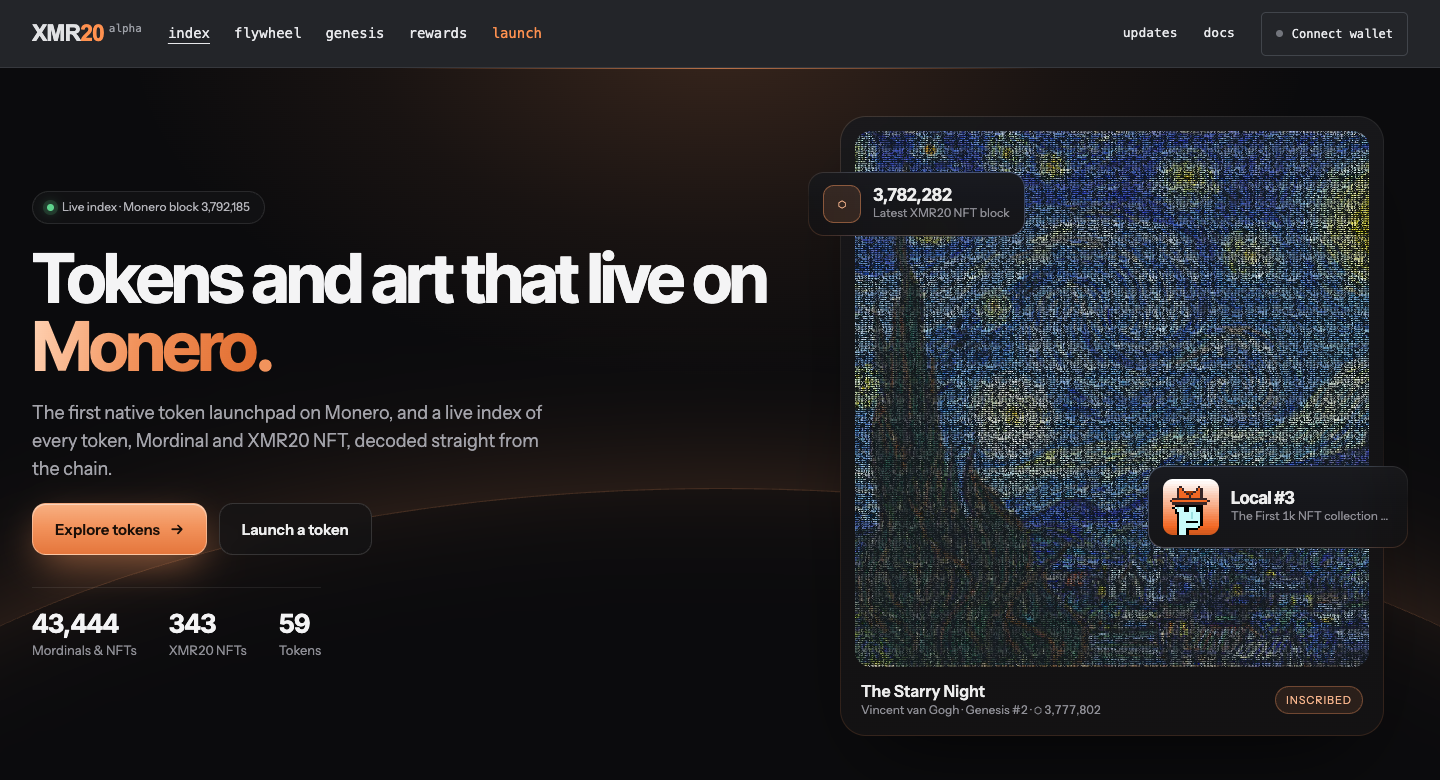
The released homepage captured on 26 October, featuring The Starry Night from Genesis and the larger artwork layout. Counts and block heights shown are from the capture.
A fresh visit opens the explorer on Tokens. Collection browsing brings Genesis together with historical Mordinal groups, while a separate filter opens the XMR20 NFT collections. The Mordinals view starts with the oldest inscriptions, making it easier to explore the history already preserved in the archive.
This is a new presentation of the token and art ecosystem we have been building: clearer entry points, more room for the artwork and a layout checked on desktop and phone. The existing launch page, wallet and earlier community updates remain part of the same site.
What we checked
The homepage redesign and enlarged artwork layout were published on 26 October. Recorded browser checks cover the homepage, token and collection routes, artwork views and the other main website pages at desktop and phone sizes. The current production deployment matches the recorded homepage release. Homepage interface verification is separate from the experimental token-format work.
Better ways to share the work and follow participation
25–26 October
We have built a private content-support workspace to turn released features into clearer explanations, draft post ideas and useful website screenshots. It draws on published updates, approved public facts and observed website changes, with posts prepared for human review. This is a behind-the-scenes workflow, not a new public portal or automatic posting to X.
The latest rewards refresh is also live. The 25 October, 21:07 UTC snapshot added ten captured FOMO theses, bringing that captured total to 292, while carrying earned holding credit forward. The rewards page continues to provide a public view of recorded community participation.
What we checked
The private content tools prepare drafts from public release evidence for human review; their scheduled source checks were verified in the development record. The published rewards snapshot is dated 25 October at 21:07:21 UTC and records 292 captured FOMO theses. Captured coverage is partial, and the refresh is not a payout.
The new format and its supporting services are on GitHub
25–26 October
PR #12 publishes the public-by-default token format, explicit shielding controls and two-transaction private sends, together with the new stagenet results. PR #13 adds the persistent indexer and bridge-service implementation.
PR #14 brings the latest wallet and service validation together, followed by pilot-configuration and migration-tooling work. These submissions give developers more of the source, operating instructions and evidence behind the progress described in this edition.
All three are public draft pull requests and remain unmerged. The research is inspectable now, while integration, review and any production release remain distinct milestones.
What we checked
GitHub confirms PRs #12, #13 and #14 are open drafts and unmerged. The latest public PR #14 branch also contains the pilot-configuration and address-based migration documents. This is research-source publication, not a release of the experimental wallet or services to production.
Evidence & release status
This edition covers work since Edition 06, completed or recorded on 25–26 October. It distinguishes the new-format public-stagenet engine rehearsal, local popup and bridge tests, a local Solana-validator rehearsal, read-only holder snapshots and synthetic migration claims. The current candidate is public by default with optional shielding; a private send from a shielded balance uses two transactions. The new token format, migration and bridge services are not live. Independent review and final settlement work remain outstanding, and native XMR trading is not enabled by these milestones. The homepage redesign and dated rewards refresh are live; the content-support workspace is private.
| Workstream | Recorded state |
|---|---|
| Native-token wallet | New format · stagenet rehearsal passed |
| Indexer and bridge | Persistent services · local integration passed |
| Existing holders | Snapshot tooling and synthetic claims · passed |
| Website | Redesigned homepage · live |
| Community progress | Content support built · rewards refreshed |
| Open source | Three new public draft PRs |
What comes next
The work is moving from individual transfer tests toward a connected native-token experience: clear public and private choices, persistent services, a practical migration path and more source available for review. Alongside that development, the new homepage gives the community a stronger place to explore the tokens and art already on Monero.
Back to all updates