Monero Market is now live on xmr20.org. After the confirmed stagenet trade covered in Edition 11, today's work brings the new market page and its order book onto Monero mainnet, with an experimental rollout focused on XMR20 token lots priced in XMR.
This is what we have been building towards across the wallet, bridge and token engine: making it easier to interact with XMR20 tokens on native Monero, from holding and transferring them to putting them up for sale. Alongside the market launch, we improved token discovery and verified a small piece of XMR20 artwork directly from the public index.
A live home for native XMR20 trading
31 October
Monero Market now has a live mainnet page and order book. The first trading rollout centres on $XMR20 sold in whole lots, with prices set in native XMR. You can browse the new market at xmr20.org/market/.
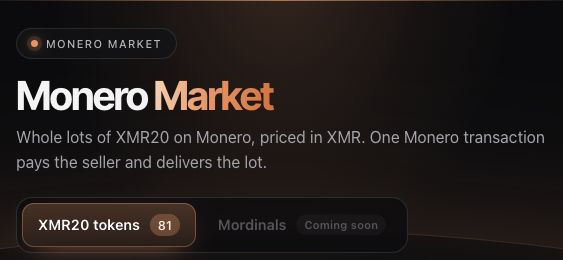
The live market introduction, captured on 31 October. The initial rollout focuses on XMR20 token lots priced in XMR.
A lot is simply a fixed bundle of tokens offered at one total price. The seller chooses the quantity and price, and the buyer takes the whole bundle. The settlement design brings the XMR payment and the transfer of the token lot together in one Monero transaction.
The market now connects through the website's own Connect wallet button, bringing native trading into the same wallet experience used elsewhere on xmr20.org. The dedicated extension market flow has also been developed and tested alongside it.
The launch is labelled experimental. The current focus is XMR20 token trading, with Mordinals trading shown as Coming soon. Listings and purchases follow Monero confirmation progress, so the experience is built around on-chain settlement.
What we checked
Read-only checks confirmed that the deployed market page matches the current release, and the public order book reports mainnet and activated trading rules. The website wallet's market integration is deployed, with the shared Connect wallet entry point visible on the live page. A recorded extension connection check also passed. These checks establish the deployment and connection paths; a completed mainnet sale is not claimed.
A clearer way to explore tokens and lots
31 October
The new market interface starts with a searchable token catalogue. You can look up a name or ticker, sort by market cap, volume or change, and use the On Monero filter to focus the view. Opening a token brings its information and available lots into one page.
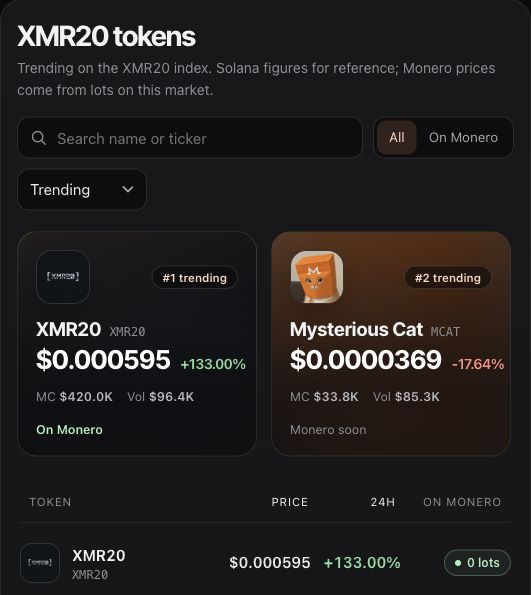
Search, filters and token cards on the live market. Prices and rankings are a snapshot from 31 October.
The catalogue now ranks using refreshed market-cap data and checks for newer launches every ten minutes. This keeps discovery connected to the evolving XMR20 index as more tokens launch.
Token pages separate Solana reference figures from Monero market information. A Solana price is context; an XMR price comes from a lot offered on Monero. The wider catalogue is useful for discovery, while this first trading rollout is focused on XMR20/XMR.
Within a token's lot view, the controls include total price, price per token, quantity and newest listings. The aim is simple: make it easy to understand what is being offered, how much XMR it costs and where it is in the confirmation process.
What we checked
The live catalogue includes current token launches, with search, sorting, the On Monero filter and separate network figures. The release records and market service source confirm refreshed ranking and ten-minute discovery of new launches. Catalogue presence does not itself mean a token has a tradable lot. The screenshots are dated snapshots of the public interface.
Bringing the wallet, bridge and market together
31 October
A working market needs the tools around it to agree about token ownership. When tokens move into a lot, the wallet and bridge need to recognize that state too. Today's coordinated update brought the live website wallet's token engine and the bridge readers onto the market rules from the same Monero start block.
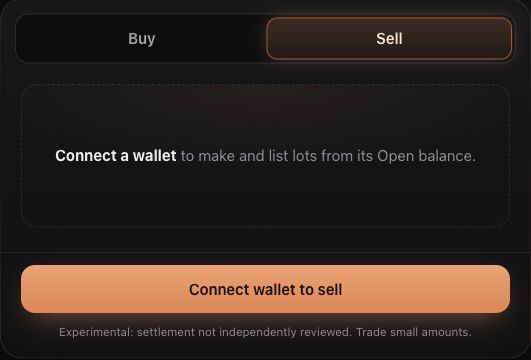
The Sell panel directs visitors into the website wallet. Captured while signed out; no wallet balances or account details are shown.
Today's website release integrates Monero Market into the site's wallet. The shared Connect wallet button sits in the header, and the market uses that signed-in session for its trading flow. The market-enabled extension remains part of the wider wallet work too.
The listing form now starts its price estimate from the token quantity and Solana dollar price, converted at the order book's XMR/USD rate, with a dollar-equivalent note for context. Native settlement is still priced in XMR. Progress messages and a working animation make it clearer when the wallet is preparing an action.
The public wallet repository remains the foundation for developers who want to inspect the code and build their own interfaces. Today's live website integration and installed extension rollout are separate from the downloadable builds published on 30 October; those earlier downloads should not be treated as the new market release.
What we checked
Deployment records confirm the shared market start block, updated bridge readers and live website-wallet market integration. The current release also includes the listing-price estimate and progress interface. Earlier extension upgrade checks preserved accounts and saved scan progress. GitHub's published downloads at the original drafting check remained extension 0.1.124 and CLI 0.3.0 from 30 October.
Preparing each trade with privacy in mind
31 October
We also worked on how token lots use Monero outputs. Each lot is tied to a small output called an anchor. Spending that anchor is part of moving the lot, so it helps the token ledger recognize a sale or cancellation.
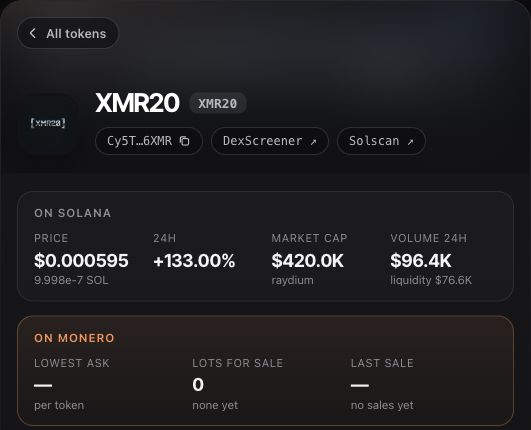
The XMR20 detail page separates Solana reference figures from native Monero lot information. Public market records remain visible.
The updated wallet prepares this anchor in advance through an ordinary payment to itself, without an XMR20 inscription in that preparation transaction. When the anchor is later spent, it appears among Monero's ring candidates. The design avoids identifying it simply because it was created inside the lot's own inscription transaction.
The implementation also selects ring candidates that predate the point when the anchor was named. That way, the publicly visible age of the lot does not narrow those candidates by ruling out newer outputs. Tests exercise preparation, resale, cancellation and finding prepared anchors after restoring a test wallet.
This is privacy-conscious preparation for Open token trading. Open lot and sale records remain public; it is separate from the encrypted notes used for Private token transfers. Keeping that distinction clear helps explain what each part of the technology does.
What we checked
The 31 October implementation and recorded test results cover spare-anchor preparation, ring-age selection, resale, cancellation, recovery and the wallet waiting for a prepared anchor before continuing. The mainnet market build uses this preparation path for token lots. These are development checks, not an independent security review or a claim that public market activity is hidden.
432 bytes of XMR20, inscribed on Monero
Public indexing verified 31 October
There is also a small visual milestone to share: a 432-byte WebP version of the XMR20 logo is now visible in our public Mordinals index. The record is registration 43102, titled XMR20 compatibility test.
The inscription was mined on 30 October, and today we verified its public indexing and downloaded image. The image matches the exact bytes submitted, giving us a concrete mainnet example people can open and inspect.
This was a standard Mordinals registration and rendering test. It demonstrates artwork appearing in the public index; ownership transfers and marketplace support are separate workstreams.
What we checked
Registration 43102 points to Monero block 3,795,664 and transaction b053a710ebe6ce7f5c163bc0d5089e7825739e1f4e046e4b7db3c18f94b90689. The public image returned successfully and matched the recorded SHA-256 hash, with a file size of 432 bytes. This verifies the indexed artwork, not a completed NFT trading integration.
Evidence & release status
This draft covers work recorded on 31 October 2026, including the later website-wallet market integration. The Monero Market page, order book and website market wallet are deployed on mainnet as an experimental rollout. Public-page screenshots were captured without a connected wallet; they show the interface and dated public figures, not a completed trade. A completed mainnet sale is not claimed. The 30 October GitHub downloads are separate from this rollout. Wallet and settlement software have not had an independent security review. The logo evidence verifies public registration and image bytes. Sources include dated development records, direct public-route checks and the public wallet repository.
| Workstream | Recorded state |
|---|---|
| Monero Market | Live on mainnet · experimental |
| Market interface | Live on xmr20.org |
| Wallet and bridge | Website market wallet live · experimental |
| Trading technology | Implemented and tested for token lots |
| Mordinals | Public mainnet record verified |
What comes next
Monero Market gives the native XMR20 ecosystem a live place to grow. Our next work is to keep bringing the trading flow, wallets and public instructions together, while sharing concrete progress people can inspect for themselves.
Back to all updates