Our latest work brings XMR20 closer to the Monero wallets people already use. Cake Wallet and Feather Wallet now have dedicated options on xmr20.org, with a website view of token holdings, signed-message token moves and a new route into Monero Market.
Since Edition 13, we have also shipped faster token-ledger startup, published new Chrome and CLI wallet downloads, opened a public checkpoint repository, and expanded the website's guides and explorer. The direction is the same across all of this: give people more choice in how they hold and use XMR20, with code and records they can inspect themselves.
Use the Monero wallet you already have
Since Edition 13 · 1–2 November
The website's Connect wallet menu now includes Cake Wallet and Feather Wallet. Choose either, enter the Monero address holding your XMR20, and the website shows its public token holdings. You can use a main address or a subaddress, including one that has never opened an XMR20 wallet.
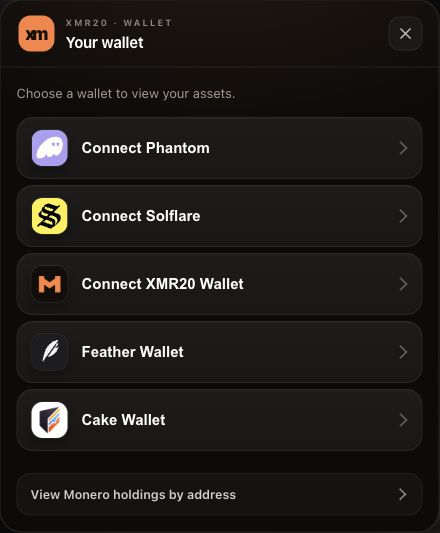
The live xmr20.org wallet selector, captured on 2 November. Cake Wallet and Feather Wallet open the website's signed-message interface; no wallet was connected for this capture.
The division is simple: xmr20.org provides the token interface, while Cake Wallet or Feather Wallet keeps your keys and signs the messages you approve. You do not import your recovery phrase into the website. Entering an address opens a read-only view; it does not give someone control of that address's tokens.
Move tokens is built into the website panel. Choose the token, amount and destination, sign the displayed message in your Monero wallet, then return the signature and pay the displayed relay fee by QR code. The separate /move/ page offers the same signed-message approach.
A signature authorises the specific token action described in the message. Signing alone does not send XMR or reveal your private keys; fee payments are separate transactions that you approve in your wallet. This flow is for Open tokens, whose holdings are public. The XMR20 wallet's encrypted Private balance remains a separate option.
The watched address also gets a website profile with its token holdings and shortcuts back to moving or trading. The guide recommends using a dedicated subaddress for XMR20 so the token address is kept separate from your other wallet activity.
What we checked
The deployed wallet selector and address-entry panel were checked on 2 November. Release records confirm the holdings panel, Move tokens flow and profile integration. The address-move implementation has recorded local test-chain checks; the new live Cake/Feather user journey remains experimental. No wallet address, signature or payment was submitted while preparing this edition.
A new route into Monero Market
2 November
Monero Market now has a dedicated Feather & Cake Wallet panel on token pages, below the chart. It brings the address view, wallet guides and signed-message trading steps together in one place.
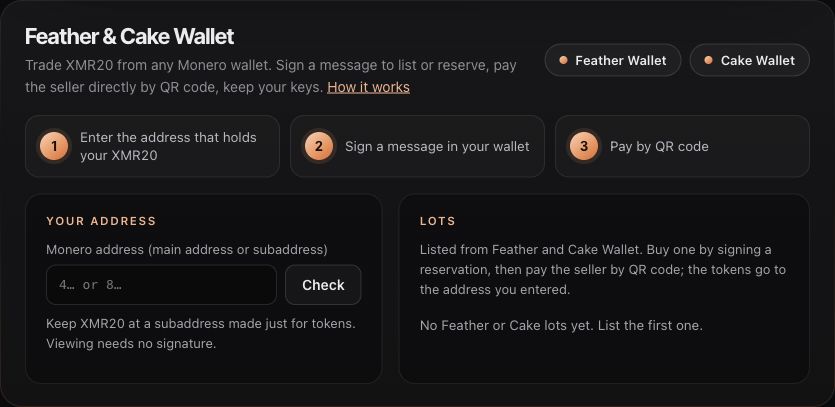
The live Feather & Cake Wallet panel on the XMR20 token page, captured on 2 November. The empty address field shows the starting interface; no trade was performed.
For sellers, the flow prepares a message describing the token quantity and asking price. The seller signs that message in their wallet and pays the displayed listing fee. For buyers, a signed reservation holds the lot while they make the payment directly to the seller, then provide proof of that payment to claim the tokens.
QR codes and copy controls carry the payment details into the wallet. The exact amount and reservation deadline matter: the claim is tied to that reservation and its payment. This is a staged sign, pay and claim flow, separate from the market's original single-transaction settlement path.
The result is another way to interact with native XMR20 using familiar Monero tools. The website supplies the token workflow; the user approves the messages and payments in their own wallet.
What we checked
The public market panel and wallet-specific guides are deployed. Twelve recorded offline test-chain checks cover the complete list, reserve, pay and claim sequence, including payment and signature validation, with the indexer and wallet agreeing on the result. These are local test results, not a claim that a Cake/Feather mainnet trade has already completed.
Token balances appear sooner, with checks on your device
2 November
We have added fast start to the XMR20 wallets. Instead of waiting to search every block before building the token ledger, the wallet begins with the indexers' list of transactions carrying XMR20 records. It fetches those transactions from a Monero node and checks their token records on the device.
The list is compared with a signed checkpoint: a dated commitment to the ledger's record count and transaction-list hash. The wallet can show the initial token balances while its own block scan continues. Sending becomes available after the required checks finish.
In the recorded mainnet read-only test, the initial token ledger was ready in about 1.3–3.1 seconds for a history containing 23 records. The full block-verification pass continued afterward. That is a measured result for that test history and connection, rather than a guaranteed startup time for every wallet.
The faster start keeps a verification path behind it. If the wallet discovers a missing or reordered record while checking the blocks, it falls back to reconstructing the token history from the chain.
What we checked
Recorded tests compare the fast-start result with a full scan and exercise incomplete, reordered and mismatched lists. The mainnet read-only run verified the checkpoint and completed a 5,310-block pass. The website deployment includes fast start, and the new public extension and CLI releases carry it too.
More of the wallet and verification tools are public
2 November
The latest public wallet release includes Chrome extension 0.1.134 and CLI 0.5.0. Pull request #8 is merged, bringing fast start, the address-move engine and the corresponding website wallet source into the public repository. Downloadable archives and their checksum file are included in the release.
We have also opened xmr20-checkpoints. It keeps public copies of the issuer's signed checkpoints and the transaction lists they describe, alongside a verification script that can check them against a Monero node. Developers can use their own node for that check.
A checkpoint makes the issuer's commitment inspectable; checking that the history is complete still depends on comparing it with the chain. Publishing the records and checker gives the community another way to examine that process outside the website.
These releases support the wider goal of letting people build their own XMR20 tools. The public engine, wallet examples and verification code can be studied and integrated without requiring everyone to use our own interface. The later Cake/Feather trading interface is a separate website release from these downloads.
What we checked
GitHub confirms PR #8 merged on 2 November and the wallets-2026-11-02 release is public. The merged commit's Tests workflow passed. The checkpoint repository and its verification instructions are public. The project records successful checkpoint checks against two public Monero nodes and rejection of eight altered fixtures.
Guides and interfaces that make the next step clearer
Since Edition 13 · 1–2 November
The new Feather & Cake Wallet chapter sits at the end of the wallet guides, just after Send tokens on Monero. It walks through setting up a dedicated address, viewing holdings, moving tokens, and the market's sell and buy steps. Screenshots and links to the wallets' own documentation make the signing and payment steps easier to follow.
The launchpad's Earnings choices are now presented as cards with clearer controls for the selected share and destination. The interface makes it easier to see the available choice and its breakdown before launching; available options still follow the launch configuration and pilot eligibility.
The flywheel page has also received the visual style used across the homepage, docs and Updates: clearer typography, grouped information and responsive cards. The redesign keeps its existing public data views and navigation in place.
What we checked
The live docs contain the new wallet chapter and its screenshots. Release records and public page checks confirm the Earnings picker and flywheel redesign. The Cake/Feather options are in the shared website wallet; the launchpad's separate wallet menu is not included in that integration yet.
More ways to read the public record
2 November
XMR20 Explorer now has a Transactions view with search, operation filters, pagination and links to the corresponding chain records. Its native activity feed refreshes while the page is open, covering the indexed token, bridge and private-carrier activity available to that feed.
The activity view deliberately shows a limited set of public facts such as transaction ID, block height and operation type. Wallet identities, amounts and encrypted payloads are omitted from this feed. A private carrier entry identifies a carrier transaction; it does not reveal the private transfer contents or stand for a count of individual transfers.
On xmr20.org, JSON inscriptions now have readable previews. The XMR20 deployment reference at registration 43103 provides an example: a summary of the record alongside its Monero transaction and block, with the original file available to download. The preview improves presentation without changing the inscription bytes.
Together, the activity view and record previews give the community more approachable ways to inspect what is happening on-chain. The explorer keeps its coverage and timestamps visible rather than presenting a partial index as complete history.
What we checked
The public explorer and its activity endpoint returned successfully on 2 November. The feed contained 23 projected records with only transaction ID, height, confirmations, operation, source and token-label fields. Recorded checks cover the feed's field restrictions and refresh behaviour. The website's JSON preview release and public registration link were verified in the development records.
Evidence & release status
This edition covers work since Edition 13 was published on 1 November through checks on 2 November 2026. Sources include direct Claude development records, Codex chats, live website and explorer checks, and public GitHub releases. Cake/Feather holdings and signed-message interfaces are deployed for experimental use; the reported full trading checks were performed on a local test chain, not a completed mainnet user trade. Signed messages authorise specific token actions, while XMR payments are approved separately. The public extension/CLI release and the later website integration are distinct builds. Wallet and settlement software have not had an independent security review. Screenshots show public interfaces with no wallet address entered or transaction submitted.
| Workstream | Recorded state |
|---|---|
| Cake Wallet and Feather Wallet | Live website support · experimental |
| Monero Market | Signed-message trading deployed · experimental |
| Wallet performance | Fast start deployed |
| Open-source releases | Wallet downloads and checkpoint repository public |
| Website and guides | Live interface and documentation updates |
| Explorer and public records | Activity feed and JSON previews live |
What comes next
More wallet choices, faster access to balances and more public verification tools all move XMR20 toward the same goal: making native Monero tokens easier to use and easier to inspect. We will keep building on these releases and sharing the results as the complete user journeys are tested.
Back to all updates